
The income tax system in the U.S. is considered a progressive system in which the tax rate increases as the taxable income of an individual increases. It imposes a lower tax rate on low-income earners and a higher rate on those with higher incomes. This is usually achieved by creating tax brackets that group taxpayers by income range. This contrasts with a regressive tax system (or a flat tax system), where everyone pays the same percentage regardless of income.
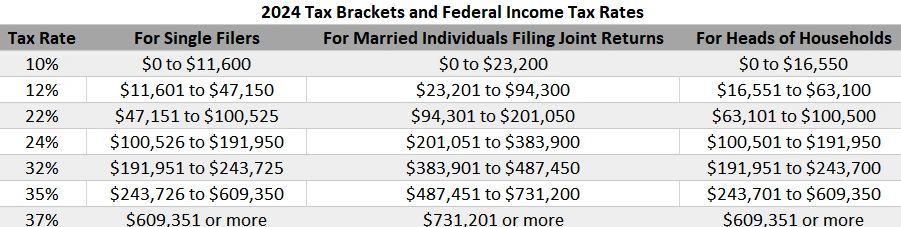
Below is the 2024 tax bracket by filing status:
As you can see, in 2024, if you file as single and have $20,000 of taxable income, you’re in the 12% tax bracket, while if you file as single and have taxable income of $650,000, you’re in the 37% tax bracket. This doesn’t mean that all your income is taxed at that rate. You only pay your highest percentage tax rate on the portion of your income that exceeds the minimum threshold for that tax bracket. In the earlier example, if you are single and have $20,000 of taxable income, $11,600 of that is taxed at 10%, and the remaining $8,400 (20,000 – 11,600) is taxed at 12%.